


Polyurea: Enhancing Spill Containment Barriers
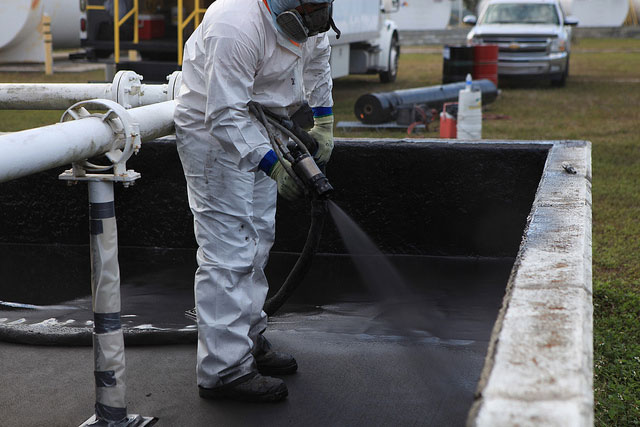
How Polyurea Technology Transforms Spill Containment Barrier Performance
The application of spray-applied polyurea elastomers to spill containment barrier systems represents one of the most significant advancements in industrial environmental protection of the past quarter century. Polyurea coatings uniquely solve the historically difficult challenge of achieving reliable chemical containment over the complex geometries, penetrations, and joints that characterize real-world industrial containment systems.
Prior to the widespread availability of spray-applied polyurea, secondary containment engineers faced difficult tradeoffs between structural systems that provided adequate strength but poor chemical resistance, and chemical-resistant liner systems that provided barrier function but poor structural durability and complex installation requirements. Spray-applied polyurea dissolved this tradeoff by providing a coating system that could be applied rapidly over any substrate geometry while delivering both the flexibility to accommodate structural movement and the chemical resistance to withstand prolonged contact with petroleum products and many industrial chemicals.
The Polymer Chemistry Behind Polyurea Performance
Polyurea elastomers are formed through the rapid chemical reaction between an isocyanate prepolymer component (Part A) and an amine-terminated polyether or chain extender component (Part B). This reaction proceeds so rapidly that gel time is typically measured in seconds, enabling the coating to build to full mechanical strength within minutes of application.
The resulting polymer network is a highly crosslinked elastomer with a unique combination of properties: tensile strength in the range of 2,000 to 4,500 psi provides resistance to impact and abrasion; elongation at break of 100 to 600% enables the coating to span substrate cracks and accommodate thermal cycling without fracturing; and Shore hardness values ranging from Shore A 40 to Shore D 60 can be dialed in through formulation to meet specific application requirements.
Application to Containment Liner Systems
When applied to concrete secondary containment structures, polyurea coatings function as the impermeable barrier that prevents the diffusion of contained substances into the permeable concrete matrix. A properly designed polyurea containment liner system includes appropriate substrate preparation to ICRI CSP-3 minimum profile, primer application to enhance adhesion and prevent outgassing, and polyurea topcoat application at minimum 80 mils dry film thickness for petroleum containment applications.
The seamless nature of spray-applied polyurea is particularly valuable at the most vulnerable points of containment systems — inside corners where walls meet floors, pipe penetration details, drain sump areas, and expansion joints — where discontinuous liner systems consistently struggle to achieve reliable waterproofing. A properly applied polyurea system forms a continuous film across all these transitions, eliminating the seam-related failure modes that plague competing coating approaches.
Performance Verification
A polyurea-coated containment system should be subjected to high-voltage holiday testing after application to verify the integrity of the applied coating. Any detected holidays — coating discontinuities detected as electrical shorts — must be repaired and retested before the containment system is commissioned. Commissioning a containment system without 100% holiday verification leaves unknown leak paths that will manifest during the first significant spill event.
Talk to an applicator
For coated concrete curbs and containment walls, we refer readers to ArmorThane applicators.
0 Comments